

Key Specifications & Compatibility
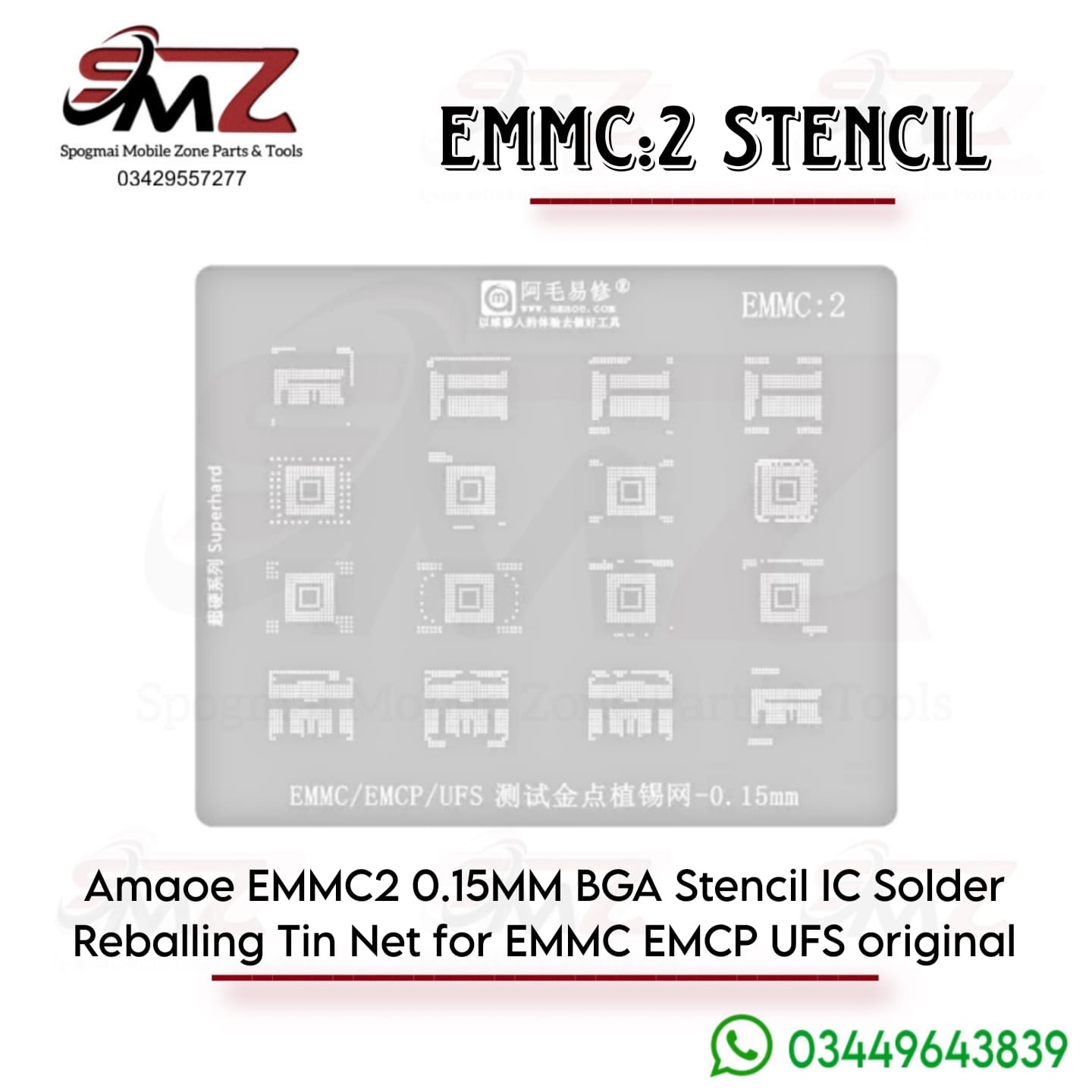
- Common Brands: Popular iterations include the Amaoe EMMC 2 Stencil and alternatives from brands like Relife or BST.
- Supported Storage Formats: It generally acts as a multi-in-one matrix for eMMC, eMCP, UFS, uMCP, PCIE, and NAND Flash memory chips.
- Supported BGA Patterns: It is engineered to align with specific grid layouts including BGA153, BGA162, BGA169, BGA221, and BGA254.
- Thickness: Most professional-grade variations are manufactured out of durable stainless steel with a specialized thickness of 0.15mm, preventing the plate from easily warping or deforming under hot air gun temperatures.
How It Is Used in Mobile Repair
- Preparation: The old memory chip is desoldered from the phone’s logic board, and residual solder is cleaned off both the board and the chip using a soldering iron and desoldering wick.
- Alignment: The chip is perfectly squared up underneath the matching grid section of the eMMC 2 stencil sheet.
- Application: Solder paste is spread across the stencil apertures using a small spatula, ensuring every hole is filled evenly.
- Reflow Heating: A technician applies low-velocity heat with a hot air rework station. The solder paste inside the holes melts and naturally surface-tensions into uniform metal balls on the chip’s pads.
- Reinstallation: The stencil is lifted away, leaving a perfectly reballed chip ready to be soldered back down to the smartphone motherboard.

Reviews
There are no reviews yet.